
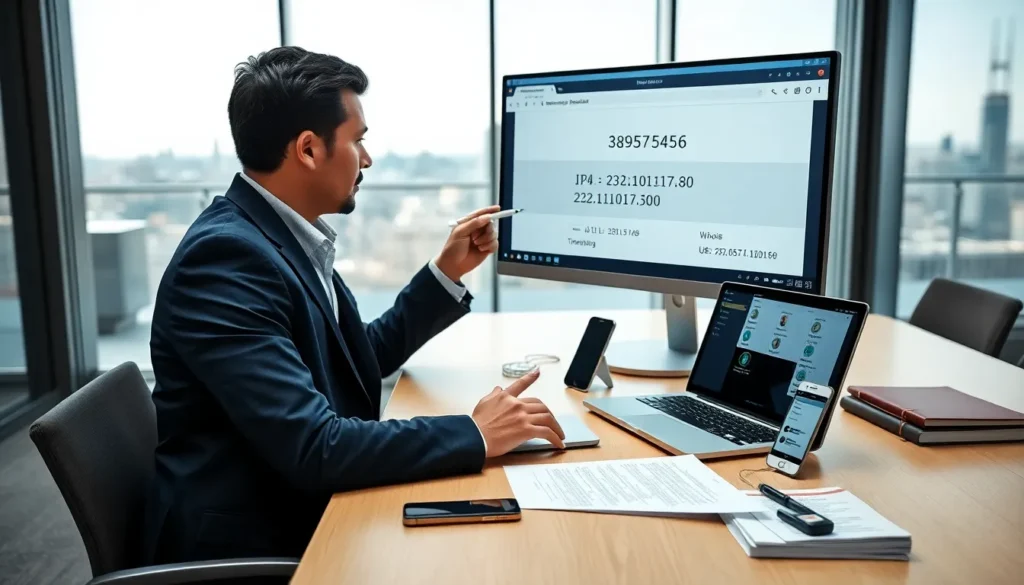

3895575456 may represent different technical or administrative identifiers. The reader will learn clear ways to test whether 3895575456 is a phone number, an IP address, a timestamp, or a product/account code. The introduction sets expectation and directs the reader to practical checks.
Table of Contents
ToggleKey Takeaways
- Treat 3895575456 as a candidate phone number first: try country-code prefixes, add local separators, and validate with a phone-validator before calling.
- Convert 3895575456 to dotted IPv4 (232.110.117.80) to check allocation, whois records, and geolocation using reputable IP tools.
- If IP and phone checks fail, test timestamp interpretations (seconds, milliseconds since 1970) and compare resulting dates against expected ranges.
- Search logs, vendor catalogs, and system APIs for matching account or product IDs, and document each lookup with sources and timestamps.
- Protect privacy: use trusted lookup services, avoid public posting of sensitive context, and contact owners only via official channels.
Could It Be A Phone Number? How To Tell
The reader should check formatting first. Phone numbers usually include a country code, area code, or separators. The string 3895575456 has ten digits. The reader can try common checks.
Check country code. The reader should test whether the first digits match a country code such as +1, +44, or +39. If 389 matches a country code prefix in a given context, then the string might be a number with missing symbols.
Add separators. The reader should format 3895575456 as 38-955-75456 or 389-557-5456 and see whether that matches local patterns. If formatting yields a valid local number, the string may be a phone number.
Use a phone validator. The reader should use an online phone validation tool and enter 3895575456 with likely country codes. The tool will report whether the number passes length and prefix rules. The reader should avoid calling unknown numbers. The reader should check further documentation before dialing.
Interpreting The Number As An IPv4 Address
A large decimal like 3895575456 often appears when systems display IPv4 addresses as integers. The reader can convert the integer to dotted-quad form. Doing so yields a familiar IPv4 address that the reader can analyze.
Conversion Steps From Decimal To Dotted IPv4
The reader should treat 3895575456 as a 32-bit unsigned integer. The reader divides the integer into four bytes from highest to lowest.
Step 1: Compute byte one by shifting right 24 bits. For 3895575456, byte one equals 232.
Step 2: Compute byte two by shifting right 16 bits and masking. For 3895575456, byte two equals 110.
Step 3: Compute byte three by shifting right 8 bits and masking. For 3895575456, byte three equals 117.
Step 4: Compute byte four by masking the lowest 8 bits. For 3895575456, byte four equals 80.
The reader then assembles the bytes into 232.110.117.80. The reader can validate this address with standard IP tools.
What The Resulting IP Can Indicate (Allocation, Geolocation, Reserved Ranges)
The reader can query whois or IP allocation databases for 232.110.117.80. The address can fall into public allocation blocks or into reserved ranges. The reader should expect one of three outcomes.
Public allocation. The lookup can return an ISP or organization name and a registration region. The reader can use that information to understand ownership.
Special or reserved ranges. The lookup can show that the address falls into special blocks used for multicast or documentation. The reader should check the IANA reserved ranges list.
Geolocation. The reader can use geolocation services to map 232.110.117.80 to a country, region, or city. The reader should treat geolocation as approximate. The reader must not assume exact physical position from geolocation alone.
Could It Be A Timestamp, Account ID, Or Product Code?
The reader should test alternative interpretations if phone and IP checks fail.
Timestamp check. The reader can treat 3895575456 as seconds since 1970-01-01 UTC. Converting 3895575456 seconds yields a date in the year 2093. The reader should ask whether that future date fits expected data. If not, the reader should test milliseconds or other epoch bases.
Account ID check. The reader can search system logs, database schemas, or API documents for the pattern 3895575456. Many systems issue identifiers in sequences. The reader should look for similar numbers to infer format rules.
Product code check. The reader can look up the number in vendor catalogs or product databases. If the system uses numeric SKUs, the reader may find an exact match. The reader should use vendor search pages and avoid guessing.
How To Look Up Or Verify The Number Safely
The reader should use safe, authoritative tools for verification. The reader should avoid untrusted services that collect data.
IP and whois. The reader can use official whois services and registry portals. The reader should copy 232.110.117.80 into a reputable whois site and note the netblock owner and contact information.
Phone validation. The reader can use validated phone libraries or vendor portals. The reader should avoid calling unknown numbers until they confirm ownership.
Timestamp tools. The reader can use standard date converters. The reader should test seconds, milliseconds, and other epoch bases.
Search engines and vendor sites. The reader can place 3895575456 in quotes in a search engine or use vendor search pages. The reader should scan results for reliable sources and cross-check matches.
APIs and logs. The reader can query system APIs or check server logs where the number appears. The reader should use proper permissions and follow privacy rules.
Privacy, Security, And Practical Next Steps For Web Visitors
The reader should treat unknown numeric identifiers with caution. The reader should avoid exposing personal data when probing the number.
Do not publish. The reader should not post the number with personal context on public forums. The reader should redact sensitive details when asking for help.
Use secure tools. The reader should use well-known services for lookups. The reader should prefer tools with clear privacy policies.
Contact owners through official channels. If the reader finds an organization that owns 232.110.117.80 or 3895575456, the reader should contact them through published support channels. The reader should avoid informal outreach.
Log and record checks. The reader should document lookup steps and results. The reader should record timestamps and sources so others can verify the work.
If the reader needs help, they should share non-sensitive context and follow platform rules. The reader should protect account credentials and avoid revealing private keys or session tokens when investigating identifiers like 3895575456.


